

Part 3. How to Submit a Generic Drug to the FDA: Your Guide to ANDA Success
In Parts 1 and 2, we tackled the critical early steps in bringing a generic pharmaceutical product to market—selecting the right drug and navigating development. Now it’s time to face the final phase: submitting your data to the FDA for approval.
This part of the journey is less about strategy and more about execution. The rules are clear. The expectations are detailed. Now it’s your job to present the data in a way the FDA can review and approve.
So, what does that actually involve?
The ANDA: Your Ticket to Market
To bring your generic to the U.S. market, you’ll need to submit an Abbreviated New Drug Application (ANDA)—a structured package of data that proves your product is a safe, effective, and equivalent alternative to a reference-listed drug (RLD).
Unlike a full NDA, the ANDA skips safety and efficacy trials. But it must demonstrate:
Bioequivalence
Pharmaceutical quality
Manufacturing control
And it must do this in a format that the FDA understands: the Common Technical Document (CTD) (1) .
The CTD Format: Your Submission Blueprint
The CTD is a five-part structure used by regulators around the world. For the FDA, it must be submitted electronically, via the eCTD gateway (2).
Here’s what each module includes for an ANDA:
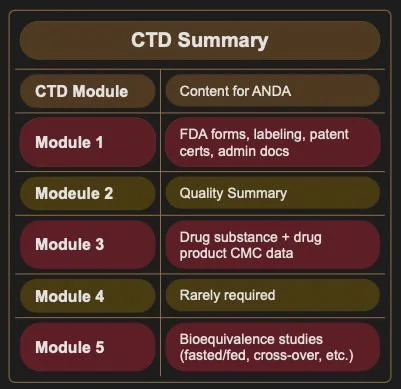
Tip: Treat the CTD not just as a format—but as a development roadmap. Every experiment you run, every test you validate, should feed directly into one of these modules.
Scope Creep: A Common Pitfall
Your mission is to replicate, not innovate. The more your project diverges from the RLD—whether in formulation, delivery, or data—the more risk you introduce. Wander too far, and you may accidentally turn your generic into a “new drug,” triggering NDA-level scrutiny. Stay focused. Let the CTD be your guardrails.
A Closer Look at Module 3: Quality (CMC)
While every module matters, Module 3 is your technical heart. It contains the bulk of your development data and is divided into two Sections:
CTD Section 3.2.S – Drug Substance (API)
API manufacturer details
Specifications
Analytical methods and validation
Stability data
Most of this will come from your API supplier’s Drug Master File (DMF)—which is why we recommended (in Part 2) selecting a DMF-listed supplier. But don’t just plug and play: you must show that you’ve qualified the supplier, validated their methods in your own system, and generated independent stability data for your batches.
CTS Section 3.2.P – Drug Product (Formulated Dose)
Formulation composition
Manufacturing process and controls
Product specifications (strength, release profile, stability)
Container-closure system data
Final stability testing
This is where you prove that your formulation works. You’ll need to show:
That your batches meet spec
That your manufacturing process is repeatable and in control
That your packaging won’t compromise product quality
That your product holds up over time (i.e., shelf-life studies)
Don’t Forget Module 5: Bioequivalence
Unless your product qualifies for a biowaiver, you’ll need to include:
Full bioequivalence study data
Protocols, analytics, and clinical reports
Justifications for your trial design
If you do qualify for a biowaiver (e.g., BCS Class I drug, or very simple formulation), you’ll still need to submit Module 5, but include a formal waiver justification.
This approach can save hundreds of thousands of dollars—so choose your molecule wisely.
You’re Almost There…
Submitting your ANDA is a significant milestone. If you’ve done the groundwork right—sourcing your API, aligning with the RLD, validating your data, selecting the right CDMO—this final step is all about packaging the proof.
Yes, the CTD is detailed and yes, it can feel overwhelming. Especially the first time. But help is available. For many new entrants, hiring an experienced regulatory consultant to assemble and QC your CTD modules can be the difference between first-pass approval and costly delays.
Final Thought: You Don’t Have to Do It Alone
This series has aimed to demystify the generic development process—not to suggest that it’s easy. At Oakley Business Development, we’ve helped dozens of clients navigate from product selection to FDA submission with confidence.
If you’re considering launching a generic, or already have a candidate in mind, we’d be happy to discuss how we can support your journey.
Let’s talk. Whether you need technical guidance, a strategic partner, or just a sanity check—we’re here to help.
Useful links:
(2) https://www.fda.gov/drugs/electronic-regulatory-submission-and-review/electronic-common-technical-document-ectd