Five Questions Every FDA ANDA Holder Should Answer Before Investing in European Market Entry
Introducing Oakley’s Commercial Readiness Assessment (CRA) Framework
Introduction
The decision to expand an FDA-approved pharmaceutical product into the United Kingdom or European Union is rarely limited by regulatory possibility alone.
The more significant question is whether the opportunity represents a commercially sound investment.
Many organisations naturally begin by asking:
“How do we obtain approval?”
In our experience, a better question is:
“Should this product be taken forward at all?”
Answering that question requires a broader assessment than regulatory compliance. It requires consideration of commercial opportunity, manufacturing capability, development strategy and execution risk before significant resources are committed.
At Oakley Business Development, we believe successful market entry begins with evidence before commitment.
That philosophy has led us to develop the Commercial Readiness Assessment (CRA)—a structured framework that evaluates market-entry opportunities across five interconnected dimensions before investment decisions are made.
Why We Now Refer to a Commercial Readiness Assessment
Many organisations use the term due diligence to describe early-stage evaluations.
While technically accurate, we have increasingly found that it does not fully describe the purpose of our assessment.
Our objective is not to audit work that has already been completed.
Nor is it to conduct a supplier qualification or regulatory inspection.
Instead, our role is to evaluate whether a pharmaceutical product is commercially, technically and strategically readyfor successful entry into the UK and European markets.
For that reason, Oakley now refers to this service as a Commercial Readiness Assessment (CRA).
The change reflects a forward-looking philosophy.
The assessment is designed to answer the question:
“What should we do next?”
rather than
“What has already been done?”
A Structured Framework for Better Decisions
Every market-entry opportunity is different.
However, the questions that determine success are remarkably consistent.
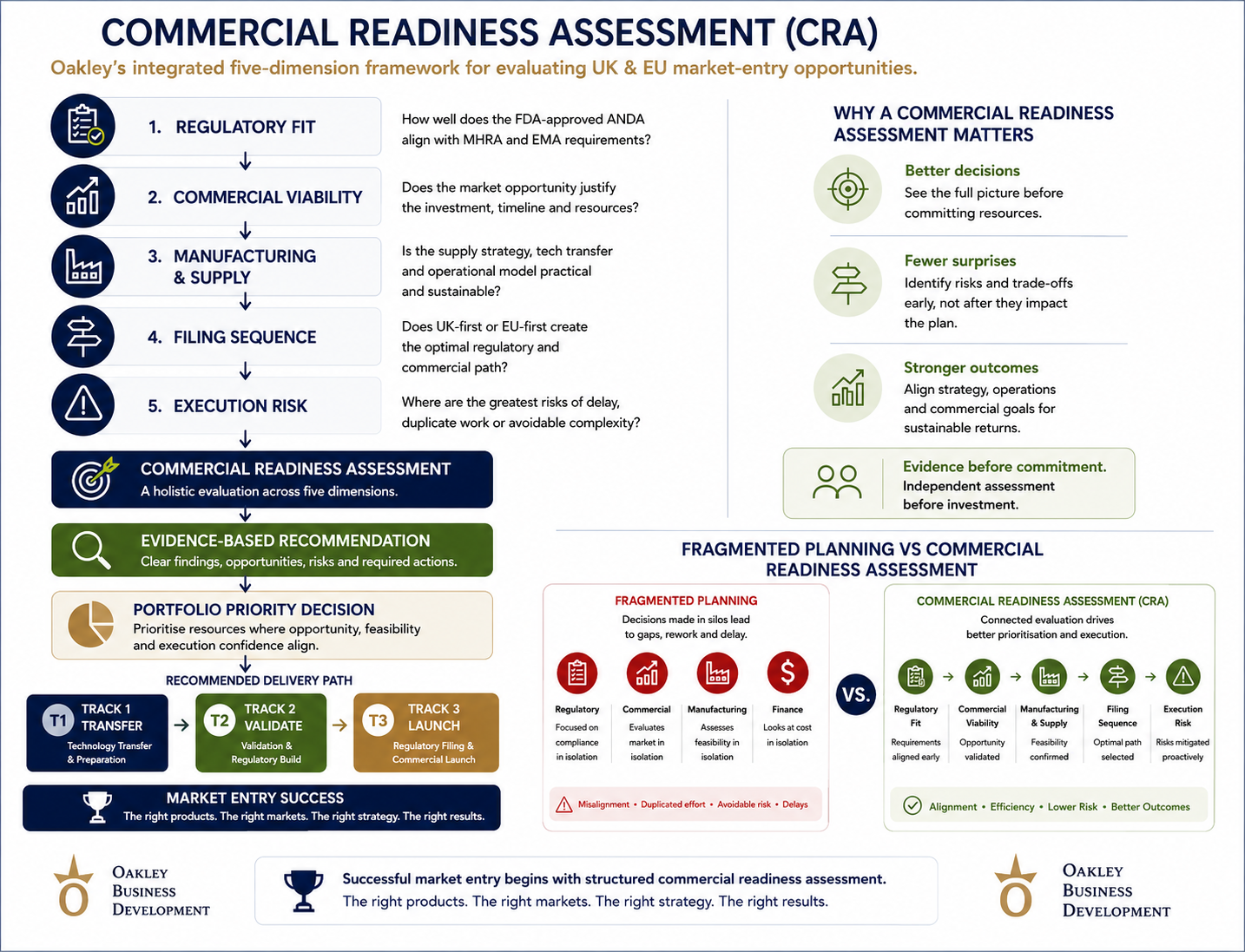
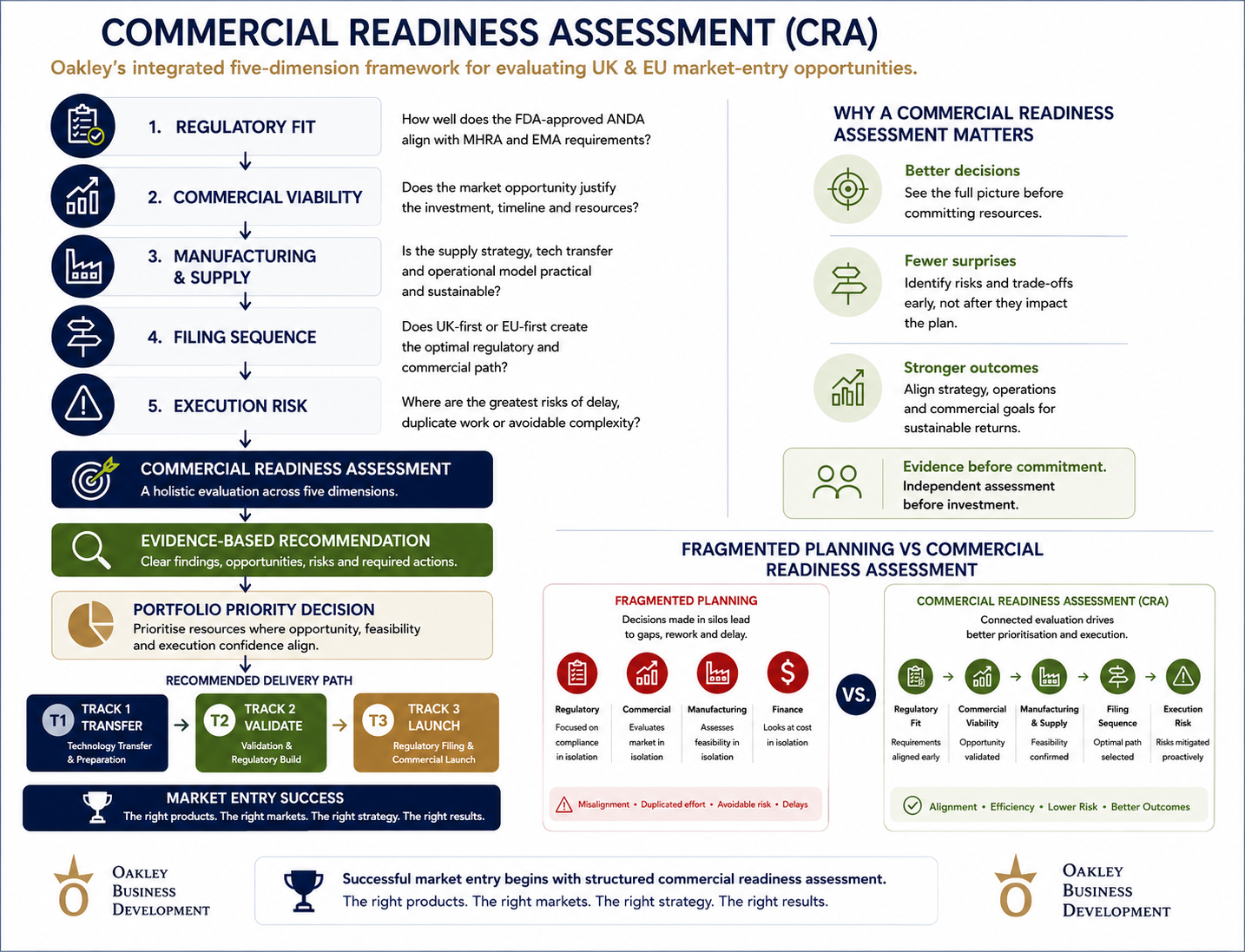
Our Commercial Readiness Assessment evaluates opportunities across five integrated dimensions.
Figure 1 – Oakley Commercial Readiness Assessment Framework
(Insert CRA Framework Graphic)
Rather than considering each discipline independently, the framework examines how these five dimensions influence one another.
This integrated approach provides management with a more complete understanding of both opportunity and risk before major investment decisions are taken.
Question 1 – Regulatory Fit
Regulatory approval remains fundamental to successful market entry.
However, FDA approval should be viewed as the beginning of the assessment rather than its conclusion.
Key considerations include:
alignment with MHRA and EMA requirements;
suitability of the existing dossier;
anticipated development activities;
regional regulatory strategy.
The objective is not simply to determine whether registration is possible, but to understand how regulatory considerations influence the overall commercial opportunity.
Question 2 – Commercial Viability
Commercial success ultimately depends upon market attractiveness rather than regulatory approval alone.
Important questions include:
Is there sustainable demand?
What competitive pressures exist?
Does pricing support an acceptable return?
Where should investment be prioritised within the portfolio?
A technically achievable project may still represent a poor commercial investment.
Conversely, relatively modest products can become highly attractive opportunities when evaluated within the correct market context.
Question 3 – Manufacturing & Supply
Manufacturing strategy is often considered after commercial decisions have already been made.
In practice, manufacturing capability frequently determines whether commercial objectives can be achieved.
Assessment therefore considers:
technology transfer;
manufacturing feasibility;
supply-chain strategy;
commercial manufacturing readiness;
operational practicality.
Question 4 – Filing Sequence
Selecting the appropriate regulatory pathway is not simply a compliance exercise.
The sequence of development activities influences both time to market and commercial return.
Questions include:
Should development begin with the UK or the European Union?
Which regulatory route best supports commercial objectives?
Can development activities be sequenced more efficiently?
Considering these issues early often avoids unnecessary delay and duplicate effort.
Question 5 – Execution Risk
Even technically attractive opportunities carry execution risk.
These risks should be understood before significant investment is committed.
Typical considerations include:
development risk;
regulatory uncertainty;
operational complexity;
commercial assumptions;
mitigation strategies.
Understanding execution risk enables organisations to allocate resources with greater confidence.
Why an Integrated Assessment Matters
The greatest value of the Commercial Readiness Assessment lies not in examining individual disciplines.
It lies in understanding the relationships between them.
Commercial opportunity influences regulatory priorities.
Manufacturing capability influences commercial strategy.
Execution risk influences investment decisions.
When these disciplines are evaluated together, management gains a far clearer understanding of both opportunity and feasibility.
This integrated approach helps organisations:
make better-informed investment decisions;
identify risks earlier;
reduce avoidable rework;
improve development efficiency;
strengthen long-term commercial outcomes.
Evidence Before Commitment
The outcome of a Commercial Readiness Assessment is not simply a report.
It is an evidence-based recommendation.
By integrating regulatory, commercial, manufacturing and strategic considerations, the assessment provides a structured basis for determining:
whether the opportunity should proceed;
where investment should be prioritised;
which development pathway offers the greatest likelihood of commercial success.
Only after those questions have been answered should detailed implementation planning begin.
Conclusion
Successful market entry begins long before the first regulatory submission.
It begins with disciplined evaluation.
By considering regulatory fit, commercial viability, manufacturing capability, filing strategy and execution risk together, organisations are better placed to invest in the right products, for the right markets, using the right development strategy.
That is the purpose of Oakley’s Commercial Readiness Assessment (CRA).
It is designed to provide evidence before commitment—and confidence before investment.
Explore the Commercial Readiness Assessment
If your organisation is evaluating opportunities to expand FDA-approved pharmaceutical products into the UK or European markets, our Commercial Readiness Assessment provides an independent, structured evaluation of commercial, regulatory and technical readiness before significant resources are committed.
Introducing Oakley’s Commercial Readiness Assessment (CRA) Framework