

For US sterile injectable companies holding FDA-approved ANDAs, international expansion opportunities often emerge organically.
A product performs well domestically. Manufacturing is established. The underlying data package is strong. Europe appears commercially attractive.
At that point, the discussion usually becomes:
“Which product should we take into the UK or EU?”
In practice, however, the more valuable management question is often:
“Which products genuinely justify expansion once regulatory, operational, and commercial realities are evaluated together?”
That distinction matters more than many organisations initially expect.
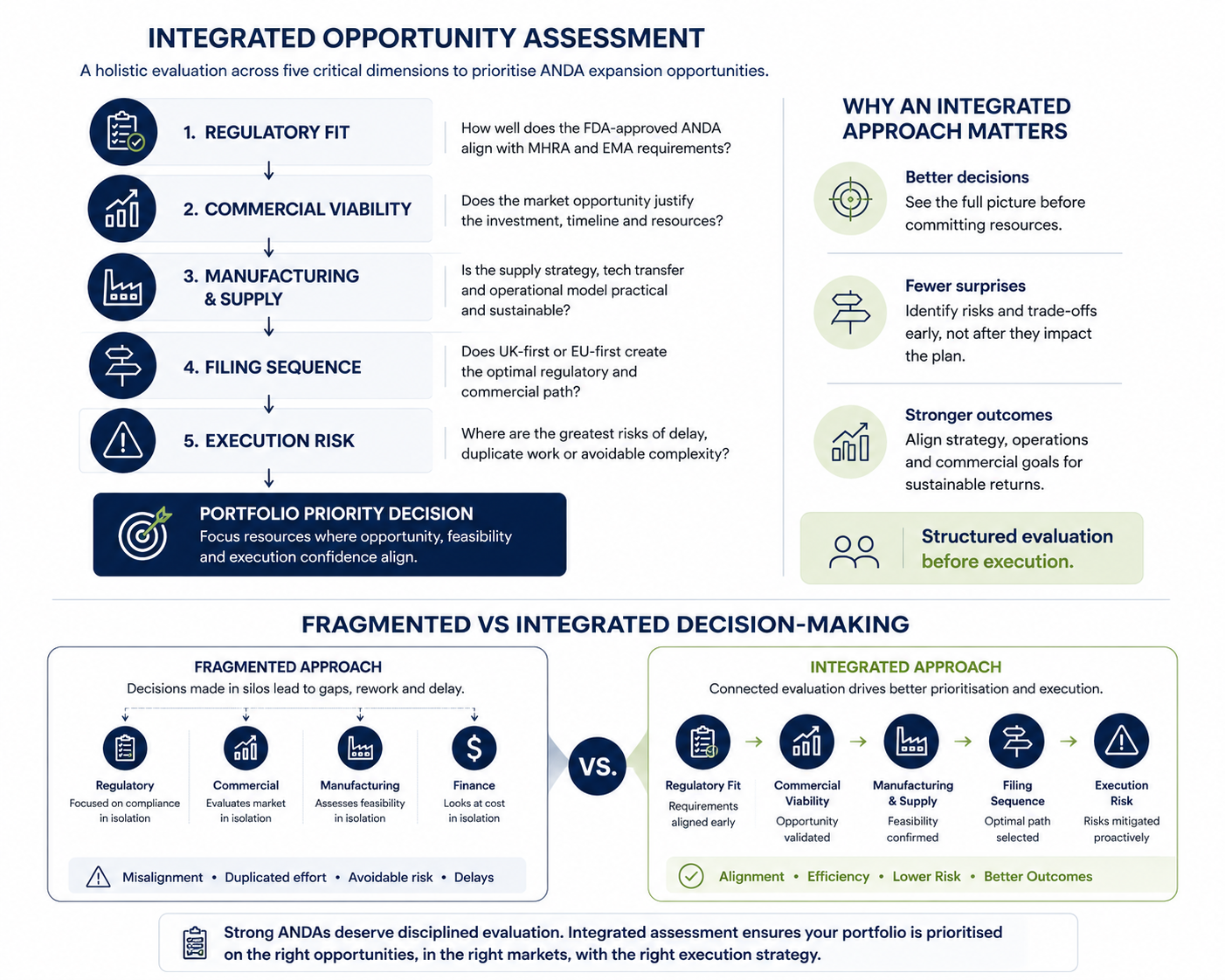
Portfolio expansion decisions are frequently evaluated in fragments
One of the most common characteristics of underperforming international expansion programmes is that decisions are made sequentially rather than structurally.
Regulatory teams assess pathway feasibility.
Commercial teams assess market attractiveness.
Technical teams review manufacturing implications.
Finance models projected returns.
Individually, each assessment may be entirely reasonable.
The difficulty emerges when these conclusions are not integrated early enough into a single operational view of the opportunity.
A product may appear commercially attractive while carrying disproportionate execution risk.
A regulatorily viable pathway may become operationally fragile once manufacturing constraints are considered.
An apparently straightforward launch sequence may create avoidable duplication, delay, or supply complexity.
When these issues surface late, programmes become reactive.
An approved ANDA is an asset — but not all assets convert equally
FDA approval represents substantial regulatory and technical achievement. It provides an important foundation for international expansion.
However, approved ANDAs do not all translate equally into UK and EU commercial opportunities.
The determining factors often include:
Alignment with MHRA and EMA expectations
Manufacturing and supply-chain flexibility
Stability and lifecycle management implications
Competitive market dynamics
Filing sequence and execution timing
Margin resilience after regional adaptation costs are considered
Viewed individually, these may appear manageable. Viewed collectively, they determine whether a programme remains commercially coherent.
This is why portfolio assessment should not be treated as an administrative screening exercise. It is a strategic allocation-of-capital decision.
Structured assessment improves both speed and decision quality
There is a common misconception that more structured evaluation slows execution.
In reality, the opposite is usually true.
When portfolio opportunities are assessed systematically:
weak opportunities are filtered earlier,
execution priorities become clearer,
duplicate work is reduced,
and regulatory, operational, and commercial decisions become better aligned.
This reduces downstream drift and allows stronger programmes to progress with greater confidence and consistency.
In sterile injectables — where manufacturing complexity, hospital pricing pressure, and supply reliability all matter — this discipline becomes particularly valuable.
Why operational structure matters increasingly in international expansion
As portfolios grow and international opportunities expand, many organisations discover that spreadsheet-driven opportunity assessment becomes difficult to scale consistently.
Maintaining visibility across:
ANDA status,
regulatory assumptions,
market opportunity,
filing sequence,
manufacturing implications,
and due diligence findings
requires a more integrated operational workflow.
This is one of the reasons Oakley developed Oakley CRM — an internal execution and commercialisation platform designed specifically to support disciplined UK and EU market-entry evaluation for FDA-approved sterile injectables.
The objective is not automation for its own sake.
It is to improve consistency, visibility, prioritisation, and execution discipline across the entire opportunity assessment process.
Conclusion
International expansion for sterile injectable portfolios is no longer simply a regulatory exercise.
For companies holding FDA-approved ANDAs, the quality of the portfolio assessment process itself increasingly determines:
which opportunities progress,
how efficiently programmes execute,
and whether commercial outcomes ultimately justify the investment.
The most effective organisations are rarely the ones pursuing the greatest number of opportunities.
They are usually the ones making the clearest decisions earliest.