

Why the Most Expensive Mistake in European Market Entry Happens Before You File Anything
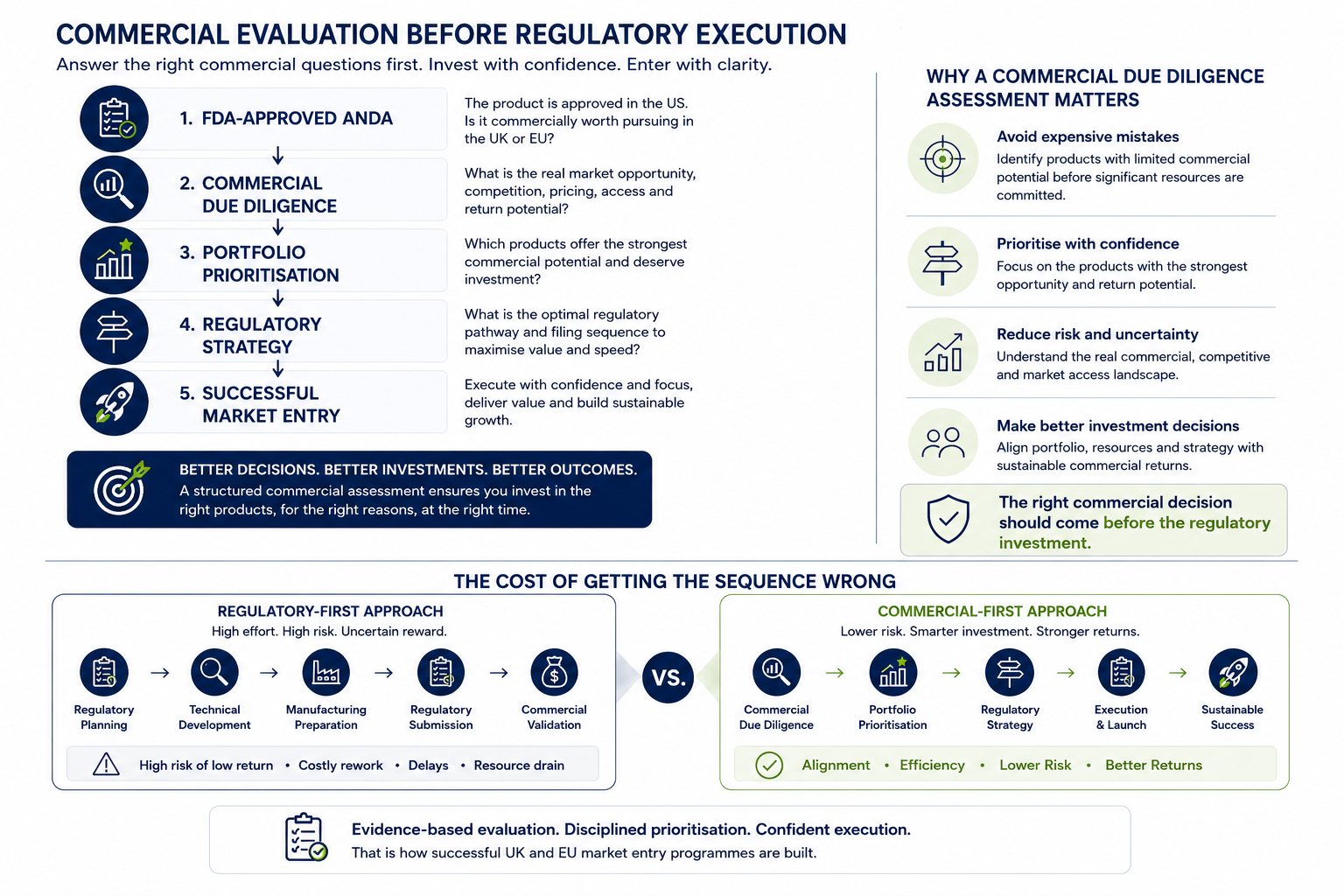
For many US pharmaceutical companies, expanding into the UK and European markets begins with a regulatory discussion.
Which procedure should we use?
Should we start with the UK or the EU?
How long will approval take?
What data will we need?
These are all sensible questions—but they are rarely the first questions that should be asked.
In my experience, the most expensive mistakes occur before any regulatory strategy is selected. They arise when organisations invest time and money pursuing products that, while technically approvable, offer limited commercial opportunity once they reach the market.
Regulatory approval is an achievement.
Commercial success is a different challenge altogether.
Approval Does Not Guarantee Opportunity
A product may already hold FDA approval through an ANDA, yet still prove unattractive in Europe for reasons that have little to do with regulation.
Questions worth asking include:
Is there an established clinical demand?
How competitive is the market?
What pricing environment exists?
Are there procurement barriers?
Are reimbursement mechanisms favourable?
Is there a realistic route into hospital purchasing frameworks?
Does the expected return justify the investment?
These questions deserve careful consideration before significant resources are committed.
A Commercial Decision Before a Regulatory Decision
Many organisations naturally begin by exploring regulatory pathways.
I would argue that the sequence should often be reversed.
The first decision should be:
“Is this product commercially worth pursuing?”
Only once that question has been answered does it become worthwhile investing in regulatory planning, technical transfer and launch preparation.
This approach reduces uncertainty, improves portfolio prioritisation and allows management teams to allocate resources more effectively.
Oakley’s Due Diligence Offering
At Oakley Business Development, we have developed a structured Due Diligence Offering specifically for FDA-approved sterile injectable products.
Rather than beginning with assumptions, we begin with evidence.
Our assessment combines:
FDA Orange Book intelligence
Portfolio review
UK and EU commercial evaluation
Competitive landscape assessment
Market access considerations
Opportunity prioritisation
Practical launch observations
The objective is not simply to produce another report.
It is to provide senior management with the information needed to decide whether a product represents a commercially attractive opportunity before larger investments are made.
Better Decisions, Earlier
Commercial due diligence is not about eliminating risk.
Every expansion programme carries uncertainty.
It is about ensuring that investment decisions are informed by structured analysis rather than optimism or assumption.
For organisations with multiple ANDAs, it also provides a consistent methodology for prioritising products and identifying those most likely to deliver sustainable commercial returns.
Final Thoughts
European market entry should never be viewed as a purely regulatory exercise.
Successful programmes balance regulatory planning with commercial evaluation from the very beginning.
The organisations that ask the right commercial questions early are often the ones that make the best long-term investment decisions.
If your organisation is considering UK or EU expansion for FDA-approved sterile injectable products, a structured Due Diligence assessment can provide a practical foundation for those decisions—before significant time, cost and resource are committed.
About Oakley Business Development Limited
Oakley Business Development Limited specialises in supporting US pharmaceutical companies evaluating UK and EU commercial opportunities for FDA-approved sterile injectable products.
Our independent Due Diligence Offering helps organisations assess commercial viability, prioritise portfolios and develop practical market-entry strategies before committing to full programme implementation.